
Anhui Jwell Precision Mold Co., Ltd.
Anhui Jwell Precision Mold Co., Ltd.
PVC, EVA, PE new waterproofing membrane Extrusion die head: quality definer
One
In the field of modern waterproofing engineering, new types of waterproofing membranes such as PVC, EVA, and PE have stood out due to their excellent comprehensive performance and have become the mainstream choice.
New Waterproofing Membranes Offer Significant Advantages and Wide Applications
These new membranes boast numerous advantages. In terms of waterproofing performance, they possess extremely high impermeability, acting like a sturdy shield to effectively block moisture intrusion and provide a reliable waterproof barrier for buildings. Regarding temperature adaptability, their performance is equally outstanding; they do not flow or blister under high-temperature environments, consistently maintaining a stable state. In low temperatures, they remain flexible without becoming brittle, easily coping with various harsh climatic conditions and ensuring the waterproofing effect remains unaffected by temperature changes.
In terms of mechanical properties, these membranes achieve an ideal combination of high strength and good elongation. They can withstand the stress generated by structural deformation while maintaining integrity through their excellent elongation when the substrate cracks, thereby ensuring the long-term effectiveness of the waterproof layer and significantly extending the service life of the building. Particularly prominent is their aging resistance; their performance remains stable even under the long-term challenges of ultraviolet radiation, ozone, and hot and humid environments. Their service life far exceeds that of traditional waterproofing materials, providing buildings with long-lasting and reliable waterproof protection.
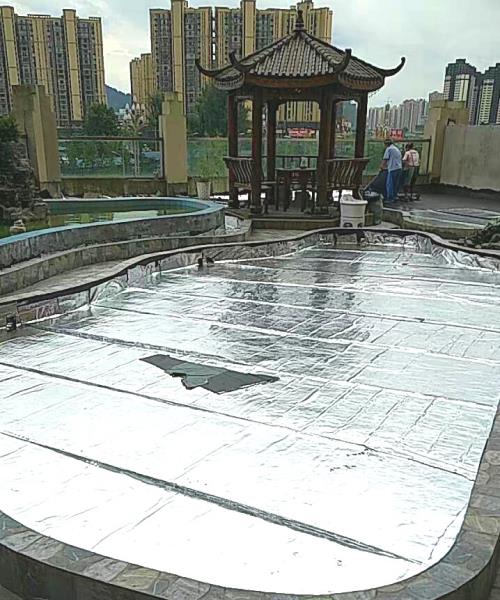
Due to their outstanding performance, the application fields for new waterproofing membranes are extremely broad. In industrial and civil construction, they are widely used in waterproofing projects for roofs, basements, and bathrooms, effectively preventing moisture leakage and protecting the safety of building structures. In the infrastructure sector, they have become the preferred waterproofing material for underground projects such as tunnels, subways, and bridges, providing a solid guarantee for the stable operation of these large-scale projects. In environmental engineering, they are commonly used for anti-seepage treatment in artificial lakes, landfills, and sewage treatment plants, preventing the leakage of harmful substances and protecting the surrounding environment.
Two
Key Production Processes and the Crucial Role of the Extrusion die head
The production process for new waterproofing membranes primarily involves stages such as material blending and plasticizing, forming and lamination, and cooling and shaping. Among these, the precise adjustment of melting point and fluidity during the initial extrusion stage, as well as the control of cooling uniformity in the subsequent calender rollers, have a direct impact on the quality of the membrane. Anhui Jwell's waterproofing membrane die (typically referring to the extrusion die) plays a dual core role throughout the entire production process, acting as both a "quality definer" and the "foundation of efficiency." It is not only the final checkpoint for membrane formation but also the key hub that transforms the upstream plasticizing results into qualified downstream products.
1. Rigorous Control of Geometric Precision: Building a Solid Quality Foundation
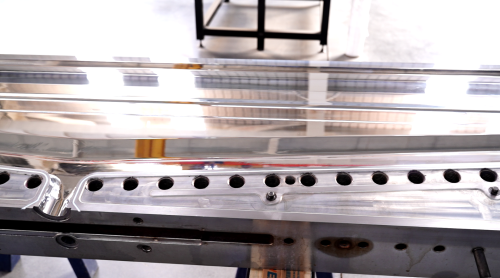
The uniformity of thickness and width in waterproofing membranes are fundamental quality indicators, directly determined by the die. Anhui Jwell's dies feature advanced designs such as coat-hanger manifolds, ensuring that the melt maintains consistent pressure and flow velocity across the entire width before entering the die lips. Poor design can lead to uneven discharge, resulting in membranes with issues like "thick in the middle, thin at the edges" or fluctuations in basis weight. The die lips are equipped with choke bars and fine-tuning adjustment screws, allowing for micron-level corrections of minor thickness variations at the edges or local areas of the membrane, providing reliable assurance for subsequent processes. Otherwise, post-formation defects would be difficult to correct, severely impacting membrane quality.
2. Enabling Composite Structures: Expanding Product Functionality
Modern waterproofing membranes often feature multi-layer composite structures, which rely heavily on die technology. Anhui Jwell's multi-layer co-extrusion dies can combine melts with different formulations or colors within the die itself, achieving one-shot extrusion. This bonding method in the molten state results in interlayer bond strength far exceeding that of post-coating or lamination, significantly enhancing the membrane's performance and quality. Whether producing homogeneous membranes or reinforced membranes laminated online with materials like polypropylene nonwoven fabric, the die's flow channel design and discharge stability are prerequisites for ensuring a smooth, stress-free composite interface, strongly supporting the expansion of membrane functionality.
3. Ensuring Production Stability: Enhancing Economic Efficiency
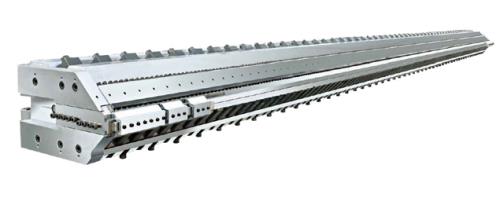
In continuous production, the stability of the die directly impacts the production line's operational efficiency and material waste. The flow channels of high-quality dies are specially polished or coated, allowing for smooth melt flow and reducing the likelihood of material stagnation and decomposition. This is particularly crucial when processing heat-sensitive materials like PVC, significantly extending continuous production time, reducing downtime for die cleaning, and improving production efficiency. Concurrently, the die's fast adjustment speed during start-up and shutdown, along with its strong self-cleaning ability during color changes, allows it to quickly reach a stable production state. This significantly reduces raw material waste, saving costs for the enterprise and enhancing economic benefits.
4. Influencing Subsequent Processes: Determining Final Product Performance
The state of the extrudate exiting the die acts like "genetic code," transferring its characteristics to all subsequent processes. If the die discharge is uneven, internal stress differences will exist within the membrane, leading to problems like inconsistent shrinkage after cooling and curling or warping at the edges. The surface finish of the die lips directly determines the initial surface condition of the membrane extrudate. For products requiring a high-gloss surface finish, precision machining of the die is the first critical step in obtaining a smooth, flawless surface, exerting a decisive influence on the final product's performance.
In summary, new types of waterproofing membranes , have been widely applied across multiple fields. The extrusion die heads used in their production process, through precision design, play a critical role in ensuring geometric accuracy, enabling multi-layer co-extrusion, guaranteeing production stability, and influencing subsequent processes. Anhui Jwell's dies serve as a core guarantee of both the quality and economic efficiency of these advanced waterproofing membranes.

Wechat account

