
Anhui Jwell Precision Mold Co., Ltd.
Anhui Jwell Precision Mold Co., Ltd.
One
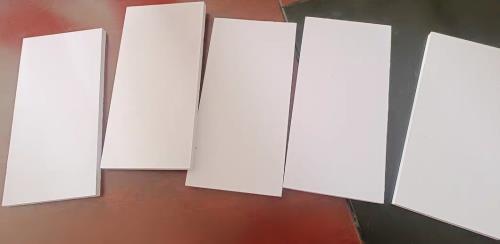
PVC free foam board (also known as Forex board or Sintra board) is a new type of composite material formed by using polyvinyl chloride (PVC) as the base material through an extrusion foaming process. It features a uniform honeycomb structure internally and a natural matte surface, offering core advantages such as being lightweight yet high-strength, completely waterproof and anti-corrosion, self-extinguishing when removed from fire, and formaldehyde-free. The material has excellent processability, allowing for sawing, planing, nailing, drilling, and engraving, as well as thermoforming, welding, and UV printing. Its strong surface adhesion makes it suitable for silk screening and picture mounting.
With outstanding weather resistance and dimensional stability, this sheet is widely used in fields such as advertising fabrication, architectural decoration, furniture and cabinetry, vehicle and vessel paneling, and chemical anti-corrosion applications. It is particularly suitable for scenarios with strict requirements for water resistance, environmental friendliness, and secondary processing.
Two
The production of PVC free foam board is centered around the conical twin-screw extrusion process. The process of Anhui JWell Precision Mold Co., Ltd. includes: high-temperature mixing and plasticizing of raw materials such as PVC resin and foaming agent according to the formula, followed by cooling and feeding into the extruder; the material melts under shear action, and the gas from the decomposed foaming agent is uniformly dispersed; the melt enters a special coat-hanger manifold die, where foaming is suppressed under high pressure and the melt is spread flat to the required width; upon exiting the die, the pressure is released, and the gas expands to form a honeycomb structure, which is then cooled and sized by a three-roll calender, and finally pulled and cut into finished products.
The processing difficulties of this material include: PVC has strong heat sensitivity and a narrow processing temperature range (180-200°C), requiring a precise balance between foaming temperature and the risk of decomposition; the melt strength must encapsulate the bubbles to prevent them from merging or escaping, otherwise, it leads to uneven density; when producing 2-20mm thick boards, the wide flow channel is prone to dead zones or flow marks due to velocity differences. Therefore, the die becomes the core technology—the coat-hanger manifold ensures uniform melt distribution, the adjustable upper lip and replaceable lower lip accommodate thickness specification changes, and the vertical restrictor bar adjustment device effectively eliminates flow defects, collectively ensuring the board's thickness accuracy and surface quality.

Three
The PVC Free Foam Board Mould die head from Anhui JWell Precision Mold Co., Ltd. is hailed as the "heart" of PVC free foam board production, and its ingenious structural design is the core solution to many technical difficulties in the foaming process of heat-sensitive plastics. Firstly, the special coat-hanger manifold design uses geometric variation to ensure that the melt flow path from the central inlet to the die lips on both sides is equal in length and the pressure distribution is completely consistent. This fundamentally eliminates the common defect of thick centers and thin edges in wide sheets, laying a solid foundation for transverse thickness uniformity. Simultaneously, the streamlined flow channel has no dead zones, completely eliminating the risk of thermal decomposition of PVC due to long-term stagnation and solving the process pain point of heat-sensitive materials being prone to burning.
Secondly, the vertical restrictor bar adjustment device acts as a precision control method. By installing a restrictor bar across the width of the die head, it can locally increase or decrease melt flow resistance, precisely correcting the velocity distribution of the melt at the die lip exit. This effectively overcomes the "M-shaped" or "W-shaped" flow defects common in wide-width production, ensuring the sheet is flat and wrinkle-free. This device is particularly indispensable when producing 2-20mm thick boards.
Furthermore, the combined design of an adjustable upper lip and a replaceable lower lip endows the production line with high process flexibility. The adjustable upper lip allows for fine-tuning to correct local thickness tolerances in real-time, ensuring board precision. The replaceable lower lip can be quickly changed according to the product thickness, easily adapting to the significant跨度 from thin to thick boards (2-20mm). This enables the same production line to efficiently produce thin boards while stably producing thick boards, ensuring that products of all specifications meet strict precision requirements.
It is the synergistic effect of these three core structures—the coat-hanger manifold establishing a uniform foundation, the restrictor bar finely regulating flow, and the adjustable lips flexibly adapting to specifications—that allows the die to transform the potential of raw material formulations and extrusion processes into high-quality sheets. This makes it the core technological equipment guaranteeing precision, efficiency, and stability in foam board production.
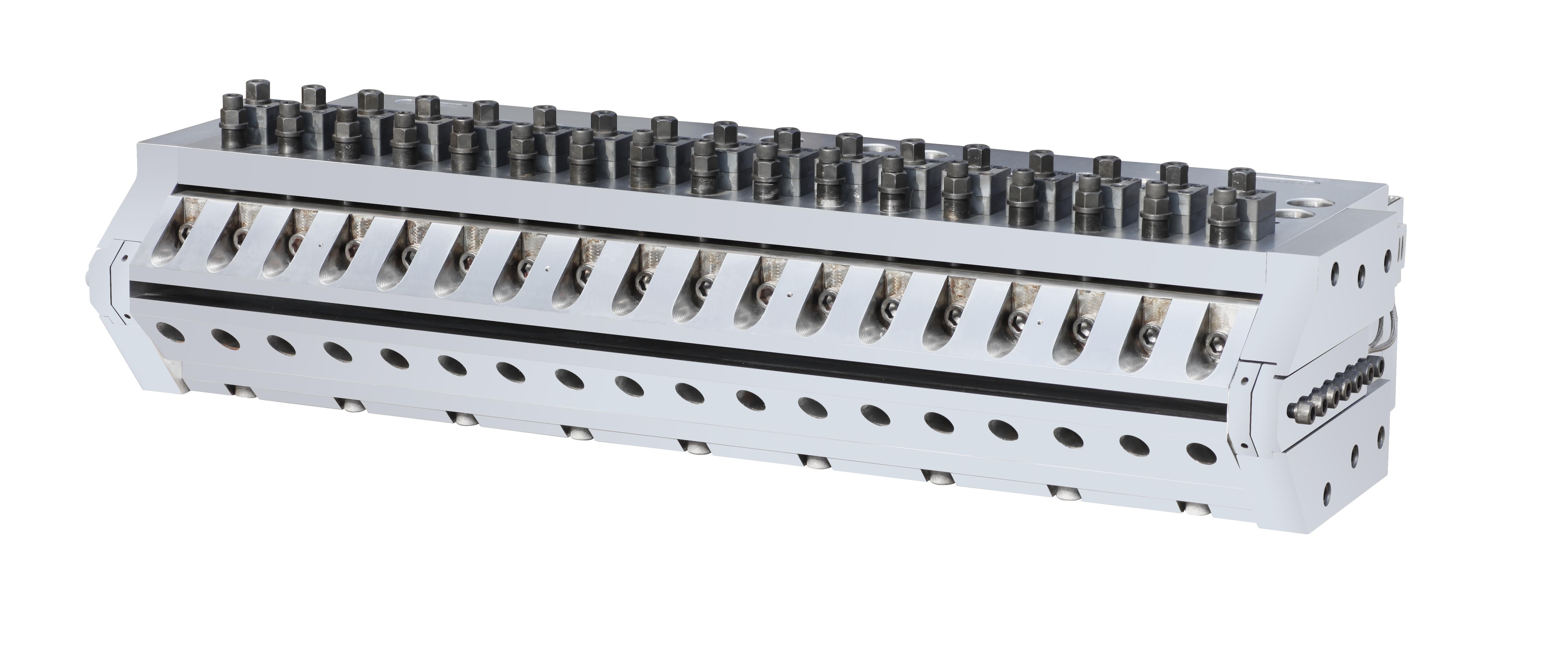
In Summary: PVC free foam board, made from polyvinyl chloride (PVC) through an extrusion foaming process, offers advantages such as being lightweight yet high-strength, waterproof, and anti-corrosion. It features excellent processability and is widely used in various fields. Its production is centered around the conical twin-screw extrusion process but faces significant processing difficulties due to PVC's high heat sensitivity, demanding melt strength requirements, and defects prone to occur in wide flow channels. The PVC Free Foam Board Mould die head from Anhui JWell Precision Mold Co., Ltd. is the "heart" of production: the special coat-hanger manifold eliminates thickness variation and the risk of thermal decomposition; the vertical restrictor bar adjustment device ensures sheet flatness; and the combination of an adjustable upper lip and replaceable lower lip provides high production line flexibility. The synergy of these three key components ensures board precision, efficiency, and stability.

Wechat account

