
Anhui Jwell Precision Mold Co., Ltd.
Anhui Jwell Precision Mold Co., Ltd.
| Design Optimization of PVC Semi-Skin Foam Board Die head | Integrated Design and Seamless Flow Channels | Inset Cooling Die | Push-Type Elastic Fine-Tuning Structure |
| The Function of PVC Semi-Skin Foam Board Die head | Ensure Structural Stability and Melt Purity | Achieves Precise Control of the Skin Layer Thickness | Provides High Precision and Flexibility in Thickness Adjustment |
One
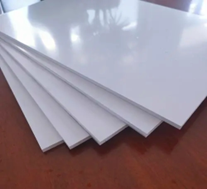
PVC semi- skinning foam board is a new type of rigid PVC foam board that bridges the gap between open-cell and skinned foam boards. Through a specialized Celuka foaming extrusion process, it forms a dense, hard skin on the board’s surface while maintaining a uniform microcellular structure in the core. This design combines the high surface hardness of skinned foam boards with the lightweight properties of open-cell foam boards, achieving an ideal balance between performance and cost. This unique “semi-skinned” structure provides significant advantages in terms of physical properties, processability, and application versatility.
Two
Characteristics and Advantages: PVC semi- skinning foam board is primarily characterized by its lightweight yet high strength. Benefiting from its cellular core, its density is typically controlled between 0.5 and 0.8 g/cm³, significantly lower than solid PVC sheets, greatly facilitating storage, transportation, and construction handling. Meanwhile, the dense surface skin endows the sheet with good mechanical strength and rigidity, allowing it to withstand certain external impacts without easy damage. Secondly, the material boasts excellent processing properties; it can be sawed, nailed, planed, drilled, glued, and otherwise machined like wood, with higher processing efficiency and less tool wear, making it ideal for large-scale, customized production. In terms of environmental adaptability, it combines characteristics such as water resistance, moisture resistance, mildew resistance, corrosion resistance, acid and alkali resistance, and flame retardancy (self-extinguishing when removed from fire). It performs excellently in harsh environments like damp areas, outdoor settings, or chemical plants, offering a long service life. Furthermore, its smooth, bubble-free surface allows for direct printing, lamination, or embossing, with long-lasting color stability, meeting the aesthetic requirements of high-end decoration and advertising displays. As a recyclable material, it aligns with the green building material trend, and its overall cost is more advantageous compared to solid wood and metal, offering outstanding cost-effectiveness.
Three
Application Fields: It is widely used in architectural decoration for exterior wall cladding, interior decorative panels, suspended ceilings, partitions, bathroom furniture, commercial display stands, and door/window trim lines, balancing aesthetics and practicality. In the advertising display industry, it is commonly used for screen printing, computer lettering, advertising signs, display boards, mounting boards, and light box backing boards, becoming a mainstream material choice due to its flat surface and easy processability. In the transportation sector, the sheet is extensively used for interior lining panels, ceilings, compartment partitions in buses, trains, and ships, as well as for recreational vehicle furniture panels, meeting the demands for lightweighting and moisture resistance. In industrial applications, it can be used for chemical anti-corrosion projects, cold storage insulation panels, environmental protection equipment housings, building formwork, and various types of packaging boxes, leveraging its strong corrosion resistance and weatherability. Additionally, in fields such as sports equipment, coastal moisture-proof facilities, photo album backings, office furniture, and children's toys, PVC semi- skinning foam board has become an important alternative material under the "plastic instead of wood, plastic instead of steel" trend due to its balanced performance, safety, and environmental friendliness, demonstrating broad market prospects.
Four
The Important Role and Advantages of PVC Semi-Skin Foam Board Die head in Producing PVC Semi-Skin Foam Boards
1. Integrated Design and Seamless Flow Channels Ensure Structural Stability and Melt Purity
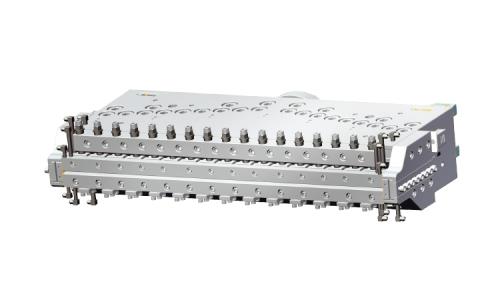
The upper and lower lips, along with the main body, adopt an integrated design, eliminating the assembly gaps and deformation risks associated with traditional split structures. Under the continuous extrusion conditions of high-pressure, high-temperature PVC foam melt, the integrated structure provides superior overall rigidity and thermal stability, ensuring that the die does not deform during long-term operation, thereby maintaining long-term stability in sheet thickness. Furthermore, the fully seamless flow channel design from Anhui Jwell prevents melt stagnation or material accumulation in “dead spots” within the flow path. This is particularly crucial for heat-sensitive, easily degradable PVC foam compounds—it effectively reduces gel specks, burned material, and flow marks caused by material stagnation, fundamentally ensuring the sheet’s surface smoothness and internal structural uniformity.
2 The Inset Cooling Die Achieves Precise Control of the Skin Layer Thickness
The inset cooling die configured at the die lip is a key process device for forming the “semi-skin” gradient structure. Through an independently controlled cooling system, it rapidly cools the surface of the sheet immediately upon extrusion, forming a dense skin layer, while the core remains at a high temperature and continues to foam and expand. This differential cooling design—external cooling with internal heating—achieves an ideal balance between skin thickness, cell morphology, and overall sheet strength. It ensures surface hardness and abrasion resistance while enabling a lightweight core. This is the core technology that distinguishes PVC semi-skin foam boards from ordinary foam boards.
3 The Push-Type Elastic Fine-Tuning Structure Provides High Precision and Flexibility in Thickness Adjustment
The push-type elastic fine-tuning structure adopted for the upper die lip is a special design tailored for PVC foam board die heads. Compared with traditional rigid adjustment methods, this structure from Anhui Jwell achieves continuous and sensitive adjustment of the die lip gap through a well-arranged screw spacing layout. Operators can perform micron-level corrections on localized thickness variations across the width of the board, precisely responding to process variables such as raw material batch fluctuations and melt pressure changes, ensuring consistent thickness across the entire width. This adjustment capability is crucial for producing semi-skin foam boards in the thickness range of 3 to 25 mm, especially in wide-board production, where it effectively eliminates the common defect of being “center-thick, edge-thin.”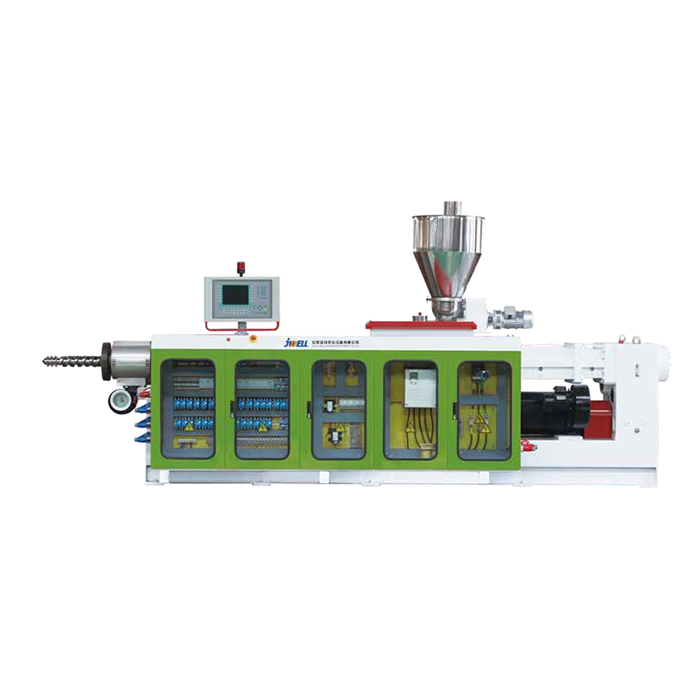
4 Comprehensive Advantages: The Technological Foundation for High-Quality Sheet Production
In summary, the design of this die integrates structural rigidity, flow channel cleanliness, cooling precision, and adjustment sensitivity. It not only solves the process challenges of PVC foam materials—which are prone to degradation and difficult to control—but also transforms the realization of the “semi-skin” gradient structure from a process dependent on experience into one that is precisely controllable through scientific structural design. For manufacturers, this translates into more stable product quality, lower reject rates, longer continuous production cycles, and greater flexibility in switching specifications. It can be said that such a high-precision, highly adaptable die is the core equipment cornerstone for achieving the goals of “high quality, high efficiency, and low loss” in PVC semi-skin foam board production lines.
Summary: PVC semi-skin foam board is produced through the Celuka foaming process, forming a dense surface layer with a foamed core in a gradient structure. It combines lightweight strength, easy processability, water resistance, flame retardancy, and a smooth surface, with a density of only 0.5–0.8 g/cm³. Its overall cost is lower than that of solid wood and metal, making it widely used in architectural decoration, advertising displays, transportation, industrial anti-corrosion, and other fields. It has become an important alternative material under the “plastic instead of wood” trend.
The core of its production lies in the die head: the integrated design and seamless flow channels ensure structural stability and melt purity, eliminating the risk of gels and deformation; the insert-type cooling die enables precise gradient forming with a “cool surface, hot core” effect, ensuring a balanced skin and foam structure; the push-type elastic fine-tuning structure provides micron-level thickness adjustment capability, effectively eliminating thickness variations across wide sheets. Anhui Jwell’s PVC semi-skin foam board die integrates rigidity, cleanliness, cooling precision, and adjustment flexibility into a single system, serving as the technological cornerstone for achieving high quality, high efficiency, and low loss in PVC semi-skin foam board production.

Wechat account

