
Anhui Jwell Precision Mold Co., Ltd.
Anhui Jwell Precision Mold Co., Ltd.
One
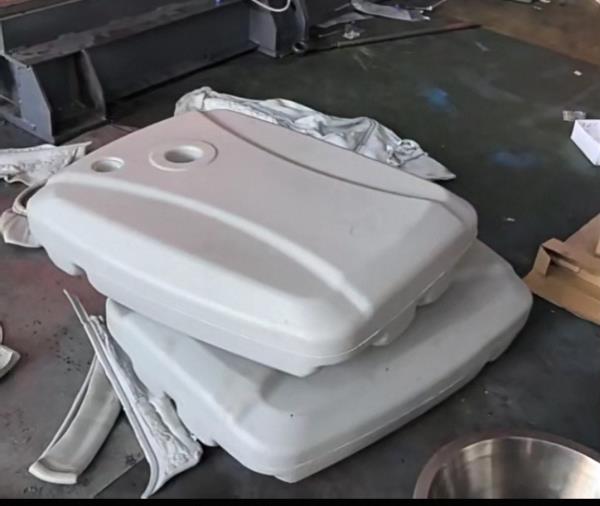
Blow molding is a manufacturing technology that uses gas pressure to expand a thermoplastic parison inside a mold, thereby forming hollow products. Its principle is similar to glass blowing. The process originated in glass bottle manufacturing, and its main steps include three stages: melting plastic to form a parison, closing the mold and blowing to shape, and cooling and demolding. Depending on the method of parison formation, blow molding is mainly divided into three types: extrusion blow molding, injection blow molding, and injection stretch blow molding. Among these, extrusion blow molding uses a rotating screw to extrude a tubular parison. It features lower equipment and mold costs, a relatively simple process, and is currently the most widely used blow molding method, capable of producing various plastic containers including daily chemical bottles, automotive parts, and industrial drums.
Two
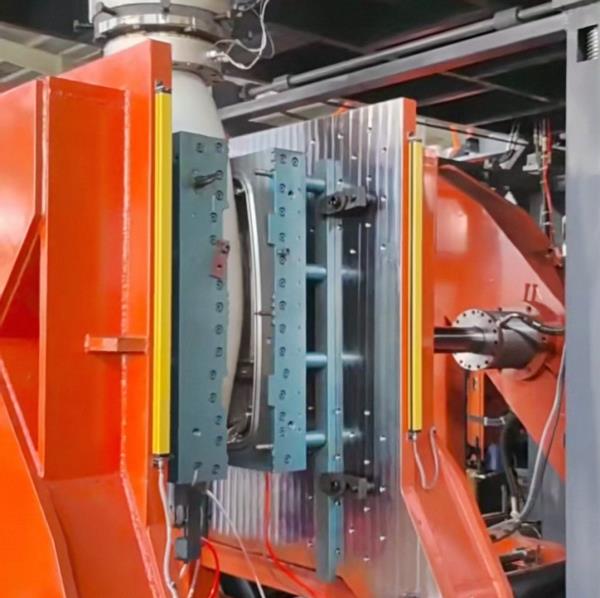
In blow molding equipment, the extruder serves as the core power source. Its function is to melt and plasticize the plastic raw material and continuously and uniformly convey the melt to the die head. The extruder mainly consists of a screw and a barrel, with the single screw being the most common structural form. After the plastic is fed from the hopper into the barrel, it is conveyed toward the die head by the rotation of the screw. During forward movement, the material is heated by external heating on the barrel and by frictional shearing from the screw, gradually melting and plasticizing, and then forms a tubular parison through the die head. The single screw simultaneously undertakes multiple tasks during the extrusion process, including solid conveying, melting and plasticizing, mixing and homogenizing, and melt conveying.
Three
The main features and advantages of Blow molding single screw in their specialized structural design and broad adaptability to various applications.
1
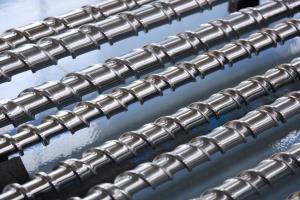
To meet the special forming requirements of blow molded products, this series of screws adopts a combined structure of a barrier section and a mixing section. The barrier section forces the melt through narrow gaps, effectively eliminating unmelted solid particles and gels, thereby preventing product defects caused by uneven plasticization. The mixing section repeatedly divides and rejoins the melt through pin or gear elements, achieving excellent distributive and dispersive mixing. The synergy of these two sections ensures uniform melt temperature, consistent composition, and stable extrusion pressure, guaranteeing highly consistent parison wall thickness even under continuous high-speed production conditions, thus providing a stable and reliable melt foundation for subsequent blow molding.
2
At the application level, this professionally designed single screw covers a wide range of hollow products, from daily necessities to industrial applications, and from lightweight to high-strength load-bearing items. In the field of automotive components, it is widely used to produce parts such as oil jugs, lubricant jugs, cooling water tanks, car seats, onboard toolboxes, air ducts, deflectors, bumpers, and rear spoilers. These products require high oil resistance, heat resistance, and impact resistance. The barrier and mixing structure ensures uniform plasticization of highly filled or modified raw materials, preventing local degradation or flow marks. In the packaging and logistics field, the screw is also suitable for various sizes of stackable drums, chemical packaging drums, and blow-molded pallets. These large-volume, thick-walled products require excellent melt strength and wall thickness uniformity. The screw's strong mixing capability ensures uniform melt distribution across a wide parison, effectively reducing eccentricity or local thin-wall defects. Furthermore, for various special-shaped pipe products, such as corrugated pipes and elbows, the screw's stable extrusion characteristics ensure that the irregular cross-sections are fully filled with high dimensional accuracy.
In summary, blow molding is a process that uses gas pressure to expand a parison inside a mold to form hollow products. The extruder's single screw is responsible for melting, plasticizing, and conveying the melt. For hollow products, Anhui JWELL's blow molding single screw adopts a barrier and mixing structure to ensure uniform and stable melt, making it suitable for automotive parts, packaging drums, blow-molded pallets, and special-shaped pipes, thereby achieving high-efficiency and high-quality production.

Wechat account

