
Anhui Jwell Precision Mold Co., Ltd.
Anhui Jwell Precision Mold Co., Ltd.
| Main Features of Hollow Building Formwork | hollow building formwork die head Advantages |
| light weight | ultra‑high precision mandrel polishing process |
| high surface smoothness | elastically adjustable upper and lower die lip design |
| water and corrosion resistance | insulation plate |
| high number of reuses and recyclable | independent zone‑controlled vacuum and temperature system for the calibration die |
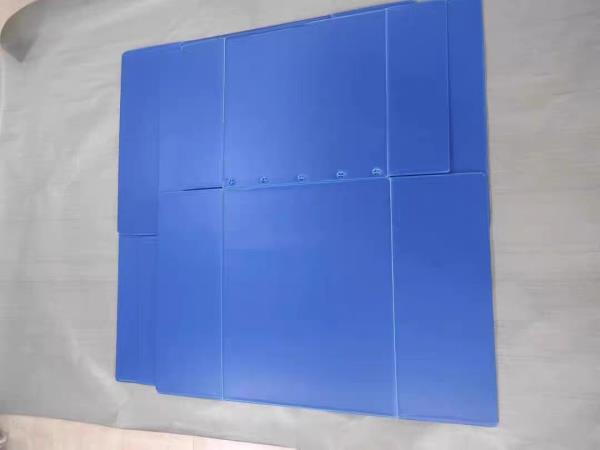
Hollow building formwork is a type of hollow structural panel made from thermoplastic materials such as polypropylene (PP) or polyethylene (PE) through an extrusion molding process. Its interior features "I"-shaped or square grid supports, offering advantages such as light weight, high strength, corrosion resistance, and recyclability. Compared with traditional wood and steel formwork, hollow building formwork demonstrates outstanding performance in construction efficiency, concrete finish quality, and overall cost control, making it an important solution for green construction in the building industry.
I. Main Features of Hollow Building Formwork
First, light weight. The hollow structure gives it a weight per unit area of only one-fourth to one-sixth that of steel formwork, making it easy to handle and assemble manually without the need for heavy lifting equipment, significantly reducing construction preparation time.
Second, high surface smoothness. Thanks to the ultra-high precision polished mandrel (with an accuracy of 0.015–0.03 microns), the inner surface of the formwork achieves a mirror-like finish. The resulting concrete surface is as smooth as a mirror, meeting the standard of fair-faced concrete without the need for plastering or leveling.
Third, water and corrosion resistance. The plastic material does not absorb water, does not rust, and is resistant to acids and alkalis, making it suitable for humid environments, coastal projects, and tunnel construction.
Fourth, high number of reuses. Under normal use conditions, it can be reused 50 to 100 times or more, far exceeding the 5 to 8 times typical of wood formwork, significantly reducing the cost per use.
Fifth, recyclable. Scrapped formwork can be fully crushed and reprocessed into pellets, generating no construction waste and meeting the requirements of a circular economy.
II. Application Advantages of Hollow Building Formwork
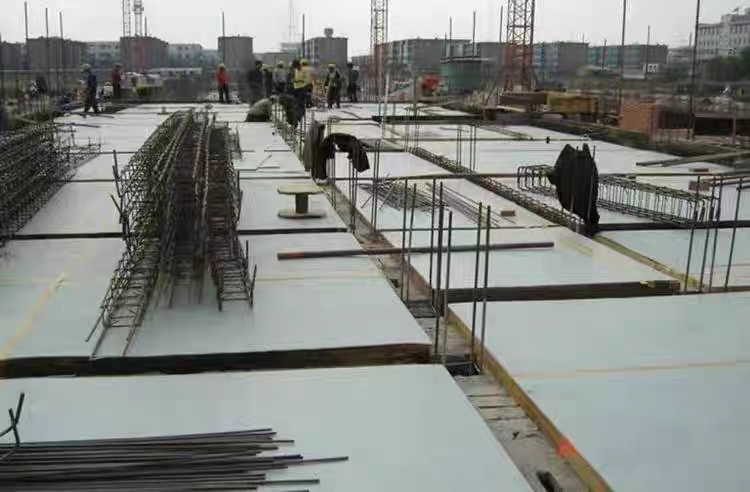
In terms of construction application, the advantages of hollow building formwork are concentrated in three aspects.
First, improved construction quality. Due to the formwork's good rigidity, non-hygroscopic nature, and uniform wall thickness, concrete components are cast with accurate dimensions, excellent verticality, and flatness. The secondary plastering process can be eliminated, allowing direct application of decorative layers, saving both time and materials.
Second, faster construction progress. The formwork is assembled using clips or pins for quick and easy installation and removal. The lightweight panels reduce labor intensity for workers, greatly improving the efficiency of formwork erection and stripping.
Third, lower overall cost. Although the initial purchase cost is slightly higher than that of wood formwork, the overall cost can be reduced by more than 30% due to the high reuse rate, elimination of release agents, no need for plastering, and recyclability of waste panels. This makes it especially suitable for high-rise buildings and projects with many standard floor repetitions.
III. hollow building formwork die head Advantages of Anhui Jwell Precision Mold and Their Impact on the Formwork
The die is a critical component in the extrusion production line for hollow building formwork. The advanced die technology of Anhui Jwell Precision Mold directly determines the final performance of the formwork.
First, ultra‑high precision mandrel polishing process. After being cut by specialized equipment, the mandrel of Anhui Jwell Precision Mold undergoes precision polishing with an accuracy of 0.015–0.03 microns, making the flow channel surface extremely smooth. The advantage of this process is that the melt flows very smoothly without stagnation or dead spots inside the die, thus preventing black spots or burnt deposits caused by material degradation from mixing into the panel. The impact on the formwork is: the inner wall of the formwork is smooth and defect‑free, and the internal flow channels are uniform. This not only ensures minimal resistance during concrete stripping but also gives the formwork higher impact strength and dimensional stability.
Second, elastically adjustable upper and lower die lip design. The upper and lower die lips can be elastically adjusted by turning the adjusting bolts, allowing precise control of the die lip gap. This design keeps the wall thickness variation within 3%, far better than the 5‑8% tolerance of ordinary dies. The impact on hollow building formwork is critical: excellent wall thickness uniformity ensures that the load‑bearing capacity is consistent across the entire formwork, with no weak spots. Under repeated use, bending, or impact, early cracking or deformation due to thickness variations is avoided, significantly extending the service life of the formwork.
Third, insulation plate. The die uses an insulation plate to effectively separate the high‑temperature zone of the die from the cooling zone of the calibration die, reducing heat loss along the axial direction of the tooling. This design optimizes the process temperature – the die can be stably maintained at the required plasticating temperature (approx. 180–220°C) without local cooling caused by the calibration die. The impact on the formwork is: the extruded parison has a uniform temperature and stable expansion rate after leaving the die, avoiding thickness fluctuations or internal stress accumulation caused by temperature variations, thereby improving the flatness and overall quality of the formwork.
Fourth, independent zone‑controlled vacuum and temperature system for the calibration die. Anhui Jwell Precision Mold 's calibration die features multiple independent vacuum zones and heating/cooling zones along its length, allowing separate adjustment of vacuum level and temperature in each zone. Uniform vacuum application ensures that the warm panel just exiting the die is tightly drawn against the inner wall of the calibration die, preventing sagging or bulging due to gravity or internal air pressure. Zone temperature control enables precise management of the cooling rate – the rapid‑cooling zone quickly sets the shape, while the slow‑cooling zone relieves internal stress. The direct impact of this process on the formwork is: the finished formwork exhibits very high flatness, no warpage, no shrinkage deformation, smooth outer walls, well‑formed internal ribs, and dimensional accuracy down to the millimeter level, directly meeting the assembly precision requirements for building formwork.
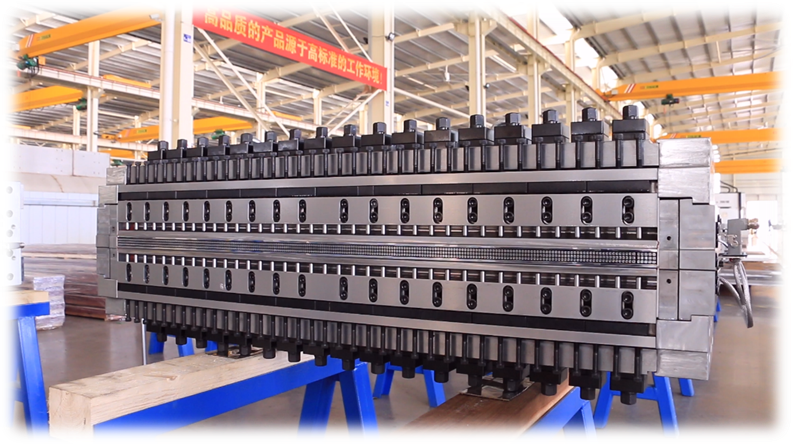
In summary:The ultra-high precision polished mandrel and elastically adjustable die lip work together to ensure uniform wall thickness and a smooth inner surface of the hollow building formwork. The insulation plate and zone temperature-controlled calibration die guarantee the formwork remains flat, stable, and free from internal stress. These hollow building formwork die head process advantages of Anhui Jwell Precision Mold elevate the quality of hollow building formwork to a new level, delivering a combination of lightweight, durability, labor-saving, and material-saving benefits in practical applications, making it an ideal replacement for traditional formwork.

Wechat account

