
Anhui Jwell Precision Mold Co., Ltd.
Anhui Jwell Precision Mold Co., Ltd.
Part 1: Polycarbonate U Type Lock-catch Hollow panel
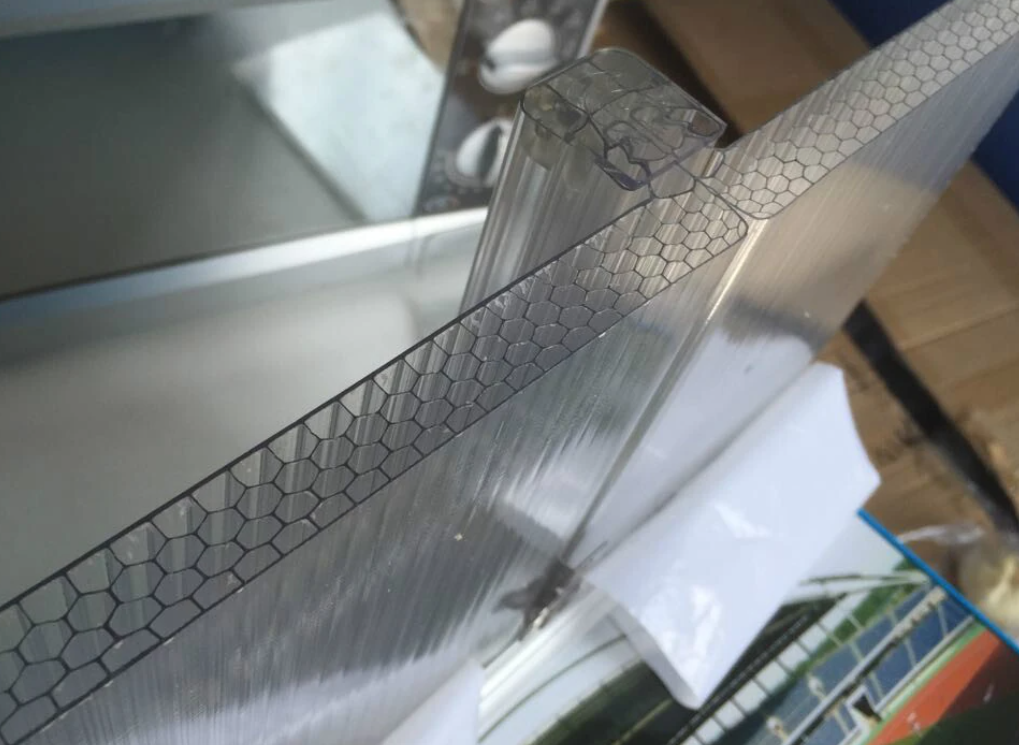
The polycarbonate U Type Lock-catch Hollow panel is an innovative building cladding system designed specifically to solve the deformation and leakage problems of traditional flat panels caused by thermal expansion and contraction under temperature variations. It uses polycarbonate or aluminum connectors to achieve interlocking connections between panels. The entire system requires no drilling on the panels. With freely sliding fasteners, the panels can expand and contract freely along the length direction under different temperature conditions, fundamentally eliminating the risk of cracking or arching caused by thermal stress.
Its upright rib edge design is a major highlight. This structure not only forms a natural water channel at the panel connections, 100% preventing water penetration at the installation surface, but also effectively blocks dust accumulation, keeping the roof or wall surface clean for a long time. In addition, the innovative U-shaped interlocking edge design makes installation extremely simple: just interlock the rib edges of adjacent panels together, no complex tools or sealants are needed. The connection is firm, and subsequent maintenance or replacement is convenient.
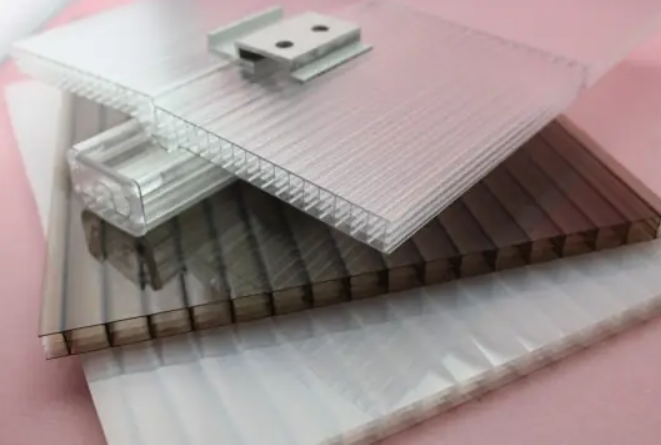
Performance and Application: Polycarbonate itself is lightweight, high-strength, highly transparent, impact-resistant, and weather-resistant. These characteristics make the interlocking panel system particularly suitable for building scenarios requiring both daylighting and durability. Whether it is a flat roof, a curved arched roof, or vertical cladding, it adapts flexibly. Therefore, it is widely used in industrial plant lighting strips, agricultural greenhouses, commercial canopies, corridor ceilings, parking lot skylights, and various curved building facades. Compared with traditional glass or solid panels, U Type Lock-catch Hollow panel s not only offer high installation efficiency and reliable waterproofing but also significantly reduce long-term maintenance costs. They are the preferred material for modern green buildings that balance functionality and aesthetics.
Part 2: U-Shaped Hollow Interlocking Panel Die – The Technical Cornerstone of High-Precision Extrusion
With the widespread application of polycarbonate U Type Lock-catch Hollow panel s in building daylighting, greenhouses, canopies and other fields, market requirements for panel texture, dimensional stability, and ease of installation are increasing. Whether an interlocking panel can achieve the design intention of "free sliding, no drilling, no water seepage" largely depends on the precision of the extrusion die and its process adaptability. Anhui Jwell Precision Mold (https://www.extrusion.cn/en/ ,+86-18755055762)'s U-shaped hollow interlocking panel die, relying on a series of advanced designs and control technologies, provides a solid guarantee for the production of high-quality PC solid sheet and multi-wall sheet.
1. The die can produce U Type Lock-catch Hollow panel s with thickness ranging from 4mm to 40mm and width from 600mm to 1050mm, covering the main demand ranges from lightweight daylighting to heavy-duty load-bearing roofs. The flexible adjustment capability for width and thickness enables the production line to quickly respond to different orders without frequent die changes, greatly improving the overall utilization efficiency of the equipment.
2. At the core technology level, Anhui Jwell Precision Mold 's die introduces Polyflow 3D dynamic melt rheology analysis software for integrated flow channel design. PC material has high viscosity and complex flow behavior. Traditional empirical designs often cause uneven melt distribution, leading to inconsistent wall thickness or insufficient filling of the interlocking rib structures. Through 3D rheological simulation, the die flow channel ensures that the melt fills uniformly across the entire width at the same speed and pressure, fundamentally eliminating internal stress concentration and weld lines, laying a solid foundation for subsequent calibration.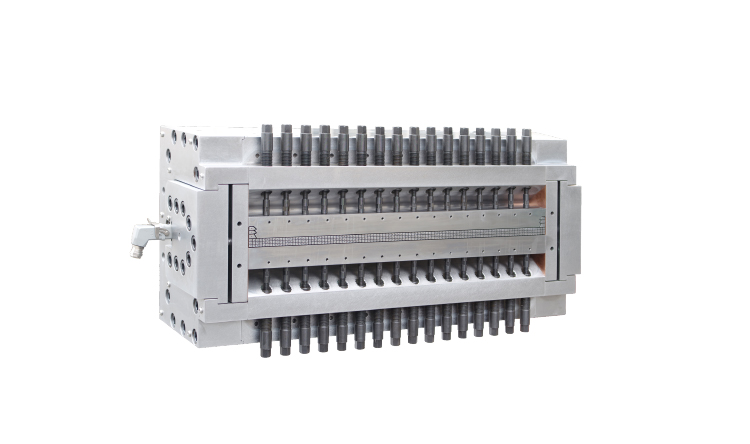
3. Particularly noteworthy is its integrated die design. Traditional multi-layer assembled dies, after long-term use, are affected by thermal expansion/contraction and changes in clamping force, easily developing fine gaps between layers, which result in material leakage or surface flow marks. The integrated structure avoids this risk, not only eliminating leakage troubles but also making disassembly, maintenance, and cleaning simple, directly extending the service life of the die. Combined with independent zone control of built-in stainless steel heating rods, the temperature in each zone of the die can be precisely set, with an error controlled within ±1°C. PC is extremely sensitive to temperature; excessive temperature differences can easily cause yellowing or degradation. The ±1°C accuracy ensures consistent melt fluidity, greatly reducing waste caused by temperature drift during production.
4. The calibration unit is another highlight of this die. The U-shaped ribs, snap-lock grooves, and other special profiles of the interlocking panel need rapid cooling and calibration after extrusion; otherwise, deformation may occur due to gravity or shrinkage stress. Anhui Jwell Precision Mold has equipped the calibration die with an independent zone-controlled uniform vacuum extraction device and temperature control system, along with a vacuum edge sealing device. This means a highly uniform negative pressure field can be formed inside the calibration die, tightly attaching the high-temperature panel to the die wall. At the same time, each zone independently adjusts the cooling intensity to adapt to the heat dissipation differences of various thickness areas. The vacuum edge seal effectively prevents air leakage at the edges, ensuring uniform airflow distribution in the shortest time, thus quickly obtaining a stable product with accurate geometry and precise interlocking fit.
Overall, this die provides comprehensive and beneficial support to the U-shaped hollow interlocking panel production process: from melt distribution, temperature control precision, to calibration efficiency, every link has been specially optimized for PC material characteristics and interlocking structure requirements. In actual production, it can significantly improve the yield rate (reducing waste panels caused by uneven wall thickness, deformation, and leakage), shorten start-up and debugging time, and support long-term continuous and stable operation. For enterprises wishing to establish quality advantages and cost competitiveness in this field, Anhui Jwell Precision Mold's U-shaped hollow interlocking panel die is undoubtedly a high-value technical solution.

Wechat account

